
Class 6 Affirmative to Negative Sentences Worksheet

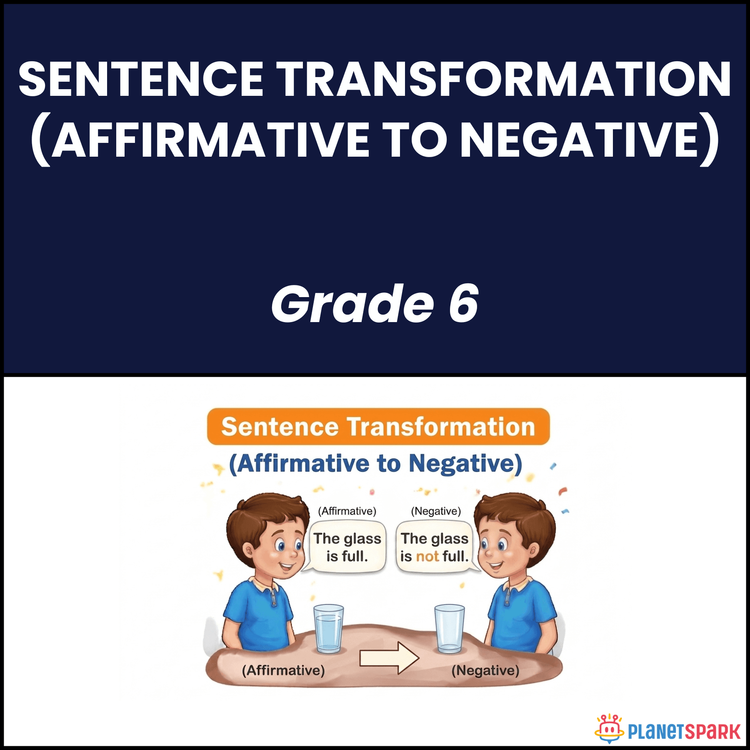
Class 6 Affirmative to Negative Sentences Worksheet
Affirmative to Negative Sentence Transformation for Class 6
This Grade 6 worksheet helps students transform affirmative sentences into negative ones. Through engaging exercises such as identifying affirmative sentences, choosing the correct negative form, and rewriting sentences in the negative form, students will gain a better understanding of how to express negation. This worksheet is designed to build grammar skills and improve sentence construction, helping students develop their writing and speaking abilities.
Why Sentence Transformation Matters in Grammar?
Transforming sentences from affirmative to negative form helps students understand negation in language. This skill is crucial for:
1. Making clear and concise statements.
2. Enhancing understanding of sentence structures.
3. Expressing ideas effectively in both writing and speech.
4. Expanding students' ability to write in different forms.
What’s Inside This Worksheet?
This worksheet includes five exercises designed to improve students’ ability to change affirmative sentences into negative sentences:
🧠 **Exercise 1 – Identify Affirmative or Negative Sentences**
Students identify whether the sentence is affirmative or negative. Example: "Riya likes mangoes."
✏️ **Exercise 2 – Multiple Choice Question**
Students choose the correct negative sentence. Example: "She likes tea" → "She *does not* like tea."
📋 **Exercise 3 – Sentence Rewriting**
Students rewrite affirmative sentences as negative sentences. Example: "He plays cricket" → "He does *not* play cricket."
📝 **Exercise 4 – Fill in the Blanks**
Students complete sentences by changing them from affirmative to negative form. Example: "She is happy" → "She is *not* happy."
✅ **Answer Key (For Parents & Educators)**
**Exercise 1 – Affirmative or Negative Sentences**
1. Riya likes mangoes. (Affirmative)
2. Meera is happy today. (Affirmative)
3. The girl does not sing loudly. (Negative)
4. The student did not finish work. (Negative)
5. Asha is not ready yet. (Negative)
6. Ravi does not play cricket. (Negative)
7. The teacher is not angry. (Negative)
8. The boy runs fast. (Affirmative)
9. Raj completed his homework. (Affirmative)
10. My friend enjoys reading. (Affirmative)
**Exercise 2 – Correct Negative Sentences**
1. b) She does not like tea.
2. b) He does not play daily.
3. b) They are not happy.
4. b) She does not eat rice.
5. a) He does not run fast.
**Exercise 3 – Rewritten Sentences**
1. She does not like tea.
2. He does not play cricket.
3. They are not happy.
4. She does not eat rice.
5. He does not run fast.
6. She is not ready.
7. They do not like games.
8. He does not read books.
9. She does not sing well.
10. He does not write neatly.
**Exercise 4 – Sample Sentences**
1. She does not like ice cream.
2. They do not play soccer.
3. He is not studying now.
4. She does not run fast.
5. He does not finish his homework.
6. I do not like pizza.
7. We do not enjoy playing together.
8. He does not finish his work.
9. She does not listen to music.
10. They do not play basketball.
**Exercise 5 – Sample Answer**
**Sample answer for the paragraph writing:**
Riya is a good student, but she does not always complete her homework on time. She enjoys reading, but she does not like writing assignments. Her friends love playing football, but she does not enjoy sports. However, she always listens carefully in class. Riya’s parents are supportive, but they do not allow her to spend too much time on her phone. She does not complain and always tries to improve herself.
Help your child master sentence transformation today with a Free 1:1 English Grammar Trial Class at PlanetSpark.
**FAQs**
**What is the importance of transforming affirmative sentences into negative ones?**
Transforming affirmative sentences into negative ones helps students understand how negation works in language. This is essential for expressing disagreement, denial, or the absence of something.
**How can my child practice transforming affirmative sentences into negative ones?**
Encourage your child to take affirmative sentences from everyday life and change them into negative sentences. For example, "She reads books" becomes "She does not read books."
**How does this worksheet help improve grammar and writing?**
By practicing sentence transformation, students learn to use the correct negative form and gain a better understanding of sentence structures. This improves their writing and communication skills by allowing them to express negation clearly and accurately.
Frequently Asked Questions
It changes positive sentences into negative ones without changing the meaning.
By identifying helping verbs and adding not or using opposite expressions.
It strengthens understanding of sentence structure and meaning changes.