
Class 6 Indirect Speech Statements Grammar Worksheet

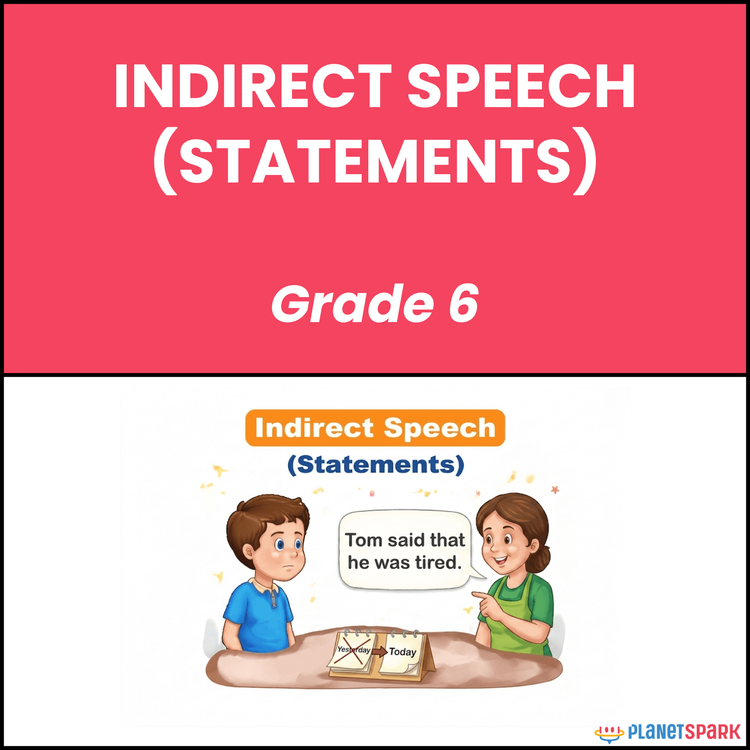
Class 6 Indirect Speech Statements Grammar Worksheet
Mastering Indirect Speech: Indirect Speech (Statements) for Class 6
This Grade 6 worksheet helps students practice converting direct statements into indirect speech. Through exercises such as identifying the reporting verb and reported clause, selecting the correct indirect speech form, and rewriting direct speech as indirect speech, students will build confidence in using indirect speech. The worksheet enhances students' understanding of how to report statements accurately, which is essential for both writing and speaking.
Why Sentence Transformation Matters in Grammar?
Indirect speech allows students to report what others have said without directly quoting them. This skill helps:
1. Improve sentence structure and grammatical accuracy.
2. Enable students to convey others' statements more naturally and fluently.
3. Build confidence in both writing and speaking in indirect speech.
4. Strengthen understanding of tense changes and reporting verbs.
What’s Inside This Worksheet?
This worksheet includes five exercises designed to practice converting direct speech into indirect speech:
🧠 **Exercise 1 – Identify Reporting Verbs and Reported Clauses**
Students underline the reporting verb and reported clause. Example: "Riya said that she was ready."
✏️ **Exercise 2 – Multiple Choice Question**
Students select the correct form of indirect speech. Example: "She said, 'I am happy.'" → "She said that she was happy."
📋 **Exercise 3 – Sentence Rewriting**
Students rewrite direct statements as indirect speech. Example: "He said, 'I will come.'" → "He said that he would come."
📝 **Exercise 4 – Fill in the Blanks**
Students complete sentences by transforming direct speech into indirect speech. Example: "He said, 'I am ready.'" → "He said that he was ready."
Answer Key (For Parents & Educators)
Exercise 1 – Reporting Verbs and Reported Clauses
1. said, she was ready.
2. said, she liked mangoes.
3. said, she was tired today.
4. said, he understood this.
5. said, she could swim well.
6. said, he would play cricket.
7. said, they should listen.
8. said, he found a coin.
9. said, he had finished work.
10. said, he would help me.
Exercise 2 – Correct Indirect Speech
1. b) She said that she was happy.
2. a) He said that he was late.
3. c) They said that they were ready.
4. a) She said that she liked tea.
5. a) He said that he could swim.
Exercise 3 – Rewritten Sentences
1. She said that she was happy.
2. He said that he was late.
3. They said that they were ready.
4. She said that she liked tea.
5. He said that he could swim.
6. She said that she was busy.
7. He said that he would come.
8. She said that she had done her work.
9. He said that he was ready.
10. She said that she had finished her work.
Exercise 4 – Sample Sentences
1. He said that he was ready.
2. She said that she would go.
3. He said that he would come.
4. She said that she had done work.
5. He said that he was busy.
6. She said that she had finished homework.
7. He said that he had seen the movie.
8. She said that she could swim.
9. He said that he had done his work.
10. She said that she would join us.
Exercise 5 – Sample Answer
Sample answer for the paragraph writing:
Riya told me that she was excited about the school trip the next day. She asked if I would join her, and I replied that I was looking forward to it too. The teacher told us to bring our lunchboxes and water bottles. We were all excited, and everyone said they were ready for the trip. Riya mentioned that it would be a wonderful day, and we all agreed. Finally, she asked if we could invite our other friends, and I told her that we should call everyone. We all said that we would have a great time.
Help your child master sentence transformation today with a Free 1:1 English Grammar Trial Class at PlanetSpark.
FAQs
What is the importance of indirect speech in grammar?
Indirect speech helps students learn how to report what others have said without quoting them directly. This is an important skill for both written and spoken communication.
How can my child practice transforming direct speech into indirect speech?
Encourage your child to practice rewriting everyday statements as indirect speech. For example, "She said, 'I am tired.'" becomes "She said that she was tired."
How does this worksheet help improve grammar and communication?
By practicing indirect speech, students learn how to report statements correctly, which enhances their ability to communicate effectively in both written and spoken forms.
Frequently Asked Questions
Indirect speech reports meaning without quotation marks and changes tense and pronouns.
Tense, pronouns, and time words often change based on reporting context.
Because multiple grammar rules apply together, requiring careful sentence changes.